These days i'm judging LIA Awards and it's interesting that more and more often you can find a lot of digital entries submitted not as separate elements of the campaign (microsite, banners or whatever) but what is submitted is the whole campaign itself, even when in "banners" category, for instance, so very often you don't know what to judge exactly. What makes me think about another thing, that is that many entries are not really powerful by themselves, but in the context of the campaign where they live that pieces become substantially relevant.
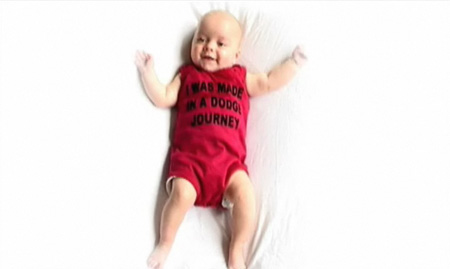
Does it make any sense judging them as in a "digital" category then? The first example of this happened when i had to judge the banners of this campaign for Dodge in Belgium, made by Proximity BBDO.
The tagline is quite simple, being Dodge a "macho" car, and trying to engage people for their new release, a familiar one, the test drive consists on going to the car dealer and have sex in the back seat of the test car. Then, if you got pregnant and have a baby within the next 9 months you get the car for free
A video clip that's an ad... Sydney agency colman rasic carrasco has just launched a music video for top UK band Radiohead. The single 'All I need', from Radiohead's critically acclaimed latest album 'In Rainbows', became a perfect fit for the idea behind the human trafficking message. The video clip was created to raise awareness of exploitation and human trafficking in developing countries.
John Lewis is a UK online and offline retailer. I've just been in the UK and saw this spot and thought is was really clever and unexpected - in fact the first time I saw it I actually didn't even know what was going on until the very end. Anyway I thought it was a nice idea which was executed very well. The second spot I found on youtube is a behind the scenes 'making of'. I believe Lowe London were the agency responsible.
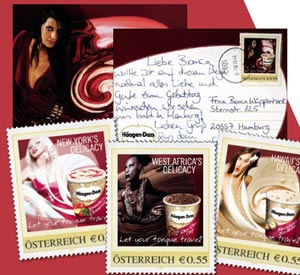
From Austria, a series of stamps sponsored by Haagen-Dazs. The icecream brand partnered with the Austrian Postal Service to produc a limited edition series of postal stamps featuring the images of their latest campaign. The idea is of TBWA Germany.
The Sunday Herald asks the question, providing the answer in two articles supporting the opposite answers YES/NO. Tina Korup (managing director of edoMidas Leadership Development) supports the NO party, saying CEO should not link their personality to a product. First of all, says Korup, CEO come and go, furthermore a CEO in ad could impact staff morale ("No CEO should be bigger than the company. As soon as a CEO puts themself in a television advertisement, they’re taking the credit and the glory for the achievements of the business’s hardworking employees. That’s very demotivating for the staff.").
On the other side, Campbell Laird (founder of brand consultancy Three Brand Design) says CEO in advertising can prove very effective for building the brand of a business since today's chief executives have the skills and personality to carry off starring in the company advertising.
This Air Sickness Bag has been created by Scholz & Friends Berlin to promote low cost flight operator Hapag-Lloyd Express. It is part of an award winning campaign (Effie Award 2005) that run last year in Italy and Germany.
With a minimum budget compared to its competitors HLX had to achieve maximum effectiveness by implementing a cross-media campaign using attention-grabbing ideas.
In the UK Barclays is about to launch a campaign to position itself as a customer-friendly bank (via Brandrepublic). It is going to be the biggest advertising campaign in four years and it will basically focus on making the bank look "human". The ads, created by Bartle Bogle Hegarty will portrait Barclays' staff as inventive and friendly.
Recently in Italy San Paolo Group did the same thing. It launched a campaign with a touch of irony starring its employees describing in an interview their role in the bank. The pay-off they used is "San Paolo, less bank more Mario" (or whatever was the employee name).
I think it is interesting to note the similar approach. Is it because their image has deteriorated or because the new consumer requires a brand to talk his same language?
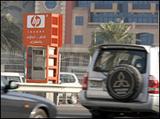
Emily from Textually pointed me to this curious news coming from the United Arab Emirates: in Dubai, speed cameras on highway are sponsored. The BBC reports Hewlett Packard is the first brand associating itself to the device. Analyst doubt this is a smart choice, since it only brings a negative image to people's mind. HP, on the other side, says this is just being a good corporate citizen by trying to persuade people to drive more carefully.
Anyway, given the driving speed on Dubai's highways (it has one of the highest accident rates per capita in the world) I doubt people will even notice the ads...
Once the "obesity" crisis has passed, food companies in the UK have decided to invest £70m in advertising. About one year ago the government was about to issue a ban on food ads to provide a solution to the obesity diffusion among teens. They eventually decided not to do it, but they obtained a positive result anyway. Basically food brands are now promoting healthier products. In an article on Media Guardian people in the industry provide different explanation to the growth: someone admits there is a trend towards healthier eating, some others, like McDonald's simply claim they are advertising more because they have more things to say...
Mr Rogovy the "inventor" of bumvertising (which means paying beggars to attach advertising stickers to their signs) has trademarked the name. Despite the undiscussed originality of the idea, concerns and polemics remain as far as ethics is concerned. Quoted in the news article, Mr Rogovy simply defines bumvertising "Possibly insensitive. Definitely accurate".
Strategiy reports global ad agency Leo Burnett has conducted research with leading pollster YouGov among 4,000 adults in the UK to understand their perceptions of 50 global cities, on a number of dimensions developed specifically to determine brand health.
New York, Sydney and London topped the list of the 50 leading city brands worldwide, ahead of Barcelona, Paris, Rome, Las Vegas, LA, Toronto and San Francisco respectively.
Vodafone is getting ready for a global branding campaign to change its strapline and reinforce its brand position as world's biggest mobile operator.
Brand Republic (sub req.) explains the campaign will debut in October, featuring the new message "Now". JWT and Bartle Bogle Hegarty are working on the project, which will presumably take advantage of a budget of over 100 million pounds (which was the amount of money used to launch the "How are you?" in 2001).