Maybe more for the media guys, but it's countless times that i have had some discussions with the media agencies that work for some of our clients over the way a campaign of ours is published. Today, while reading Techcrunch, i found this article called "Let's kill the CPM" by Shelby Bonnie, ex-CEO at CNET and now at Whiskey Media, about why he thinks the concept of CPM shouldn't be used anymore when selling a campaign. It raises some questions without giving specific answers, but i think is worth reading, at least sets the tone for a conversation on the subject, wheter you agree with him or not.
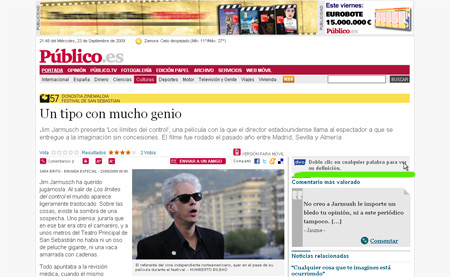
As i'm from Spain and i live in Mexico, i spend some time every day reading the online press from my country, trying to be aware of how the things are going and so on. One of the many newspapers i often visit is Publico, and reading about Jim Jarmusch presenting his new movie at San Sebastian festival i found that in the right side of the page a subtle text claims "doble clic en cualquier palabra para ver su definicion" (meaning "double click any word to get its meaning"), next to a brand called Dixio, which seems to be a service that provides real-time definitions.
A year ago, Weezer released a video for one of their singles paying homage to many different Youtube memes. That concept of mashing up different memes was what i was reminded with when i saw this video The Viral Factory has just created promoting the new Activision's Blur game, where you have to race a car and fight some other participants in a really bad mood. Every time you hit them or make a boost or something you get a message on the screen, and that messaging ("SHOCK", "BARGE", "SHUNT", "NITRO", "MINES") is what they applied for the different meme compilation, fun (and sometimes wtf) to watch.
By: daniel // Permalink // Comment(s): Category(s):Online Ads
I love Halo 3 ads, it amazes me how they advertise a game in a film style and using the top places for gamers (like IGN.com on the net or at Xbox Live from the console itself), even better than many movies. This is the latest one for "Halo 3: ODST", to be released by the end of this month:
By: daniel // Permalink // Comment(s):(3) Category(s):Online Ads
This version of Soft Cell's "Tainted Love" is one of the weirdest (yet funny) things i've seen ever: trying to get some buzz for J2O (a fruit drink) and under the "it's better to mix things up" tagline, you can get free tickets for a mixed up gig performed by Calvin Harris and Michelle Williams (from Destiny's child)
"Mach es machbar" is the name of the website done to advertise Microsoft project management tools in Germany ("Mach es machbar" means "make it feasible"). And as to prove it elbkind released this video in which Bruno Kammerl, an austrian engineer, builds and tests which is claimed the biggest waterslide in the world, stunning.
Guess what ... Some other racing games ! But this time you don't drive usual cars.
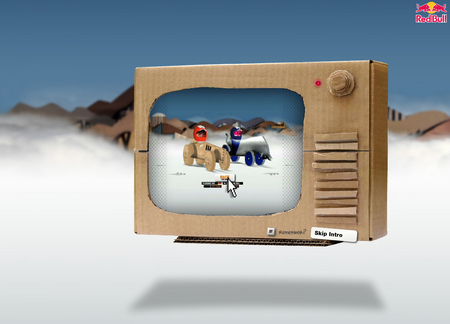
In the Red Bull one, you drive a soap box.
This site is pretty nice and the 3D environment is very well produced. The visuals and the all atmosphere really remind me of Little Big Planet ones. You can build your own soap box, your own track, customize your avatar, and compete against others. The game is to promote the soap box races that Red Bull is running across Europe.
What's better than a scottish to tell the story of an scottish whiskey, 6 and a half minutes of Robert Carlyle and the story of Johnnie Walker, brilliant (by BBH London)
By: daniel // Permalink // Comment(s):(6) Category(s):Online Ads
I love some banners when they are not intended to drive traffic to any place but being a message/experience by themselves, i guess clickthrough and some other metrics for efectiveness become relative at this point. A month ago I saw this extraordinary banner at Bannerblog. Needless to explain how well executed is that "once you pop you can't stop" motto and also a great demonstration on how important having a great copywriter helps writing ads (click on the image to see it)
By: daniel // Permalink // Comment(s):(6) Category(s):Online Ads