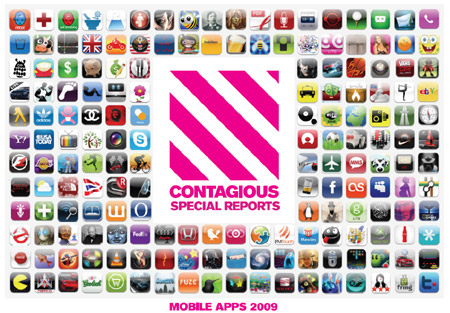
The annual best in show edited by Contagious Magazine has been released a few days ago. Once again, a great report to download for past and future reference. A part from the ugly combination of ugly dog + vuvuzelas on the cover, the rest is almost perfect...
Released earlier this month in Canada, here is a very nice film from Ogilvy Toronto and Crush for Unilever Mayo Hellmann's.
Although the phenomenon of data visualization is far from new, this is a very well executed application for a branded purpose. It shows it is not only limited to IT, artistic, or research fields but can also perfectly illustrate a message in a FMCG environment. In this case urge people to take into consideration where the food they eat comes from, and the impact it possibly has, from an economic, environmental and social point of view.
Recently, the guys at Contagious, sent me a complimentary copy of their latest report dedicated to Mobile Applications in 2009. Having developed an iPhone application myself (see Nike Goal post) I'm extremely interested in the topic and I have to say this report offers good food for thought, both for beginners and more "mature" marketers. I like it because it features the right balance of numbers, tips for brands, consumer insights and ideas' review which, in my opinion, represent the ideal mix to inspire new projects.
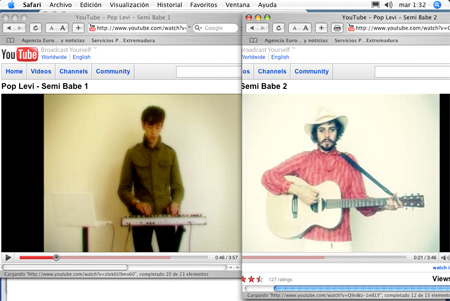
Last summer my friends Pit and Efrain sent me a link describing a strange experiment from the group Pop Levi using videos from YouTube for their single "Semi Babe".
You had to open both videos (each one of them featuring members of the group, one playing keyboards, the other one playing guitar and singing) in different browser windows and then resizing these to make both videos appear as one.
If you are looking for some good and fresh food for thought in marketing and communication, you can't miss the Contagious Communications offer. Only for this week, you can buy their reports with a 50% discount.
This year they have published 5 reports filled with in-depth analysis of the latest trends, technologies and innovations affecting today's marketing landscape. For each report there is an executive summary available, just click on the links below to download it.
The guys at GoViral got in touch with me to share some interesting stuff they have been recently working on. The first piece of content is a video of the presentation that Jimmy Maymann, GoViral's CEO, gave in Cannes last June. It's quite a long video, probably not very Web friendly, but it definitely offers good food for thought to understand how to get consumers attention online and how to activate your brand in the online media.
If you prefer reading to watching & listening, you are a lucky man (or woman) because GoViral also published a book with its research: The Social Metropolis. The book is available online in Flash version, but can also be downloaded as .pdf or, even cooler, it can arrive directly on your desktop at work... but you have to act fast... (and continue reading this post to the next page to find out what's the deal)...
I recently received a review copy of Contagious' report on Social Networking and User Generated Content, and I'd like to share the reading with you.
SN and UCG are definitely among the most debated topics of the moment, both online and offline. As usual, when there's a lot of buzz about something, you can hear/read a lot of good insights and relevant opinions but also a lot of bullshit (pardon my French...). When I received the report I read it with great interest and curiosity, because I love consumer studies (I like the idea of feeling predator and prey at the same time) and because I feel there is (and I have) still so much to learn about the fascinating Internet world. Contagious is a great magazine, therefore my expectations on the report were high. And I must say that I haven't been disappointed.
What I liked most it's the editorial approach they've taken, building a report that mixes sites overviews, consumer studies, case studies as well as opinions and insights from people who work and manage the SN industry. In my opinion, very often when you read industry or trends reports you're flooded with stats and numbers, you look at them and then you ask yourself "and now what?". With Contagious' report this is not the case.
It's quite some time I don't write about research and numbers (maybe because before I didn't care much !!??!!) but now in my new position, I have to keep my eyes open on this aspect of the business as well Thanks to the guys @ Marketingfacts (and to the brilliant powe of slideshare!), we can access a few interesting data on online advertising in Europe presented last week in Brussels by the IAB.
As you can see, UK leads the way, followed by Germany and France. Actually the info I find more interesting, is that the average expenditure per active user is 39.1€.
BrandRepublic presents the results of the 13th NetObserver Europe report which found out French internet users are the most susceptible to online advertising and marketing.
For example, in the last 6 months, over 50 percent of French Internet users had taken part in an online competition organised by a brand or an e-commerce site. In the UK the number goes down to 35 percent. Less mature markets such as Spain and Italy (sigh!) have, on the contrary a better perception of online advertising. Germans are the most difficult to please with online marketing, but when it comes to e-commerce or buying online services, they appear to be the most active.
Unfortunately I haven't been able to find the full report, so if anyone has a copy (which I believe is free), I will be eager to see it. Thanks!
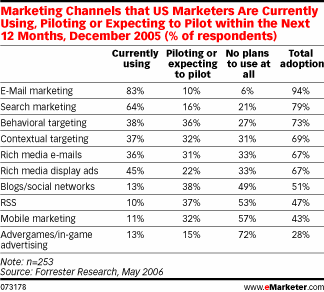
eMarketer features today an interesting chart based on Forrester's research on marketing channels used by US marketers. Once again it's a pity the results only reveal what's going on in the US, but still, it's good to know where the game is currently being played in the largest advertising market of the world.
Research company PQ Media has released last month the "Blog, Podcast and RSS Advertising Outlook". According to the study, "combined spending on blog, podcast and RSS advertising bolted 198.4% to $20.4 million in 2005, and is expected to grow another 144.9% to $49.8 million in 2006".
In future perspective PQ Media believes that podcast advertising will be a larger market than blog advertising by 2010, when blogs will comprise only 39.7%, or $300.4 million, of overall expenditures in such "alternative" online channels.
Last week eMarketer has published the results of a research by Sharpe Partners which investigated the potentials of viral marketing. The results are interesting, since they confirm the power of viral marketing: 89 percent of US users are likely to share content with friends and colleagues, and only 5 percent refuse to share content that contains a clear brand message.
According to a new research by the European Interactive Advertising Bureau, the average European internet user spends 10 hours and 15 minutes online a week; a 17 per cent rise on 2004 and a 56 per cent rise on 2003. As reported on Revolution, With the exception of early mornings (6am to 10am), the internet is the second most-used medium throughout the rest of the day. The research also found blogging is becoming more popular, with 13 per cent of European users regularly contributing to online blogging sites.